
S. NARANTSOGT: BUILDING A FINANCIAL SYSTEM RESILIENT TO CLIMATE CHANGE AND ENVIRONMENTAL RISKS
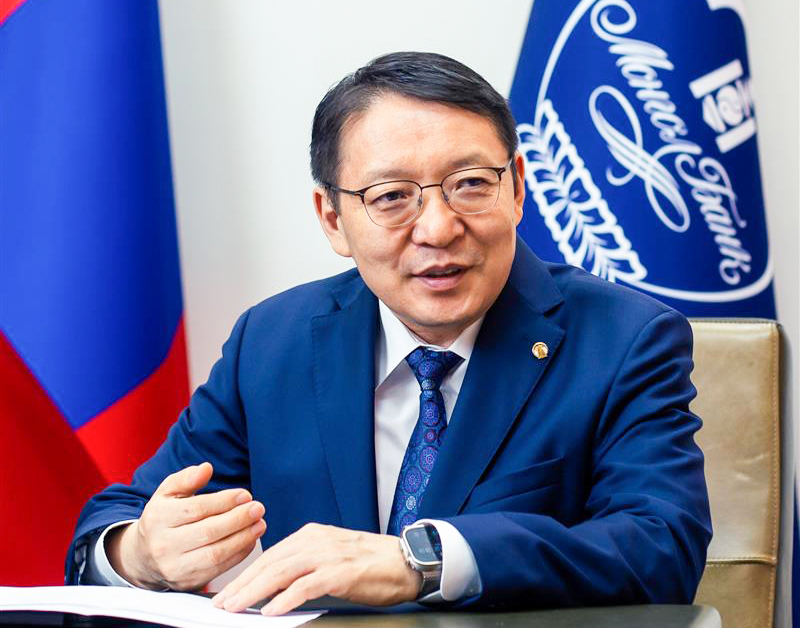
Climate change and environmental degradation have become one of the greatest challenges facing the world today. In this context, the involvement of the financial sector is becoming ever more important in shifting the economy toward a sustainable, green model of development. We spoke with S. Narantsogt, Governor of the Bank of Mongolia, about the policies the central bank is implementing to develop its sustainable and green finance framework, and about its objectives going forward.
How does the Bank of Mongolia identify the risks that climate change and environmental factors pose to the economy and the financial sector, and how is it formulating policy in response?
The Bank of Mongolia views climate change not merely as an environmental issue, but as a macro-level risk that affects economic and financial stability. Accordingly, we are working to incorporate this risk, in stages, into monetary policy, banking supervision, and financial stability policy.
Owing to its geographic location and its harsh, extreme continental climate, Mongolia is one of the most vulnerable countries to climate change. As a result, the need to shift our economy toward a low-carbon development model that can adapt to climate change is steadily growing. This transition requires substantial investment and long-term financing, and the role and involvement of the banking and financial sector is becoming ever more important.
To ground our policy in real data and research, the Bank of Mongolia is developing a big-data infrastructure, as well as consolidating information on banks' green and sustainable financing. Alongside this, we began implementing a system to measure and report the impact of green loans in 2025.
We have also developed a methodology for climate-risk stress testing in the banking sector in cooperation with the NDC Partnership and the Economic and Social Commission for Asia and the Pacific (ESCAP) and successfully carried out the first-ever climate scenario analysis covering systemically important banks. This was an important step toward embedding climate risk within banks' risk-management frameworks.
In addition, the Bank of Mongolia, in cooperation with the International Finance Corporation, Financial Regulatory Commission, and other institutions, conducted an assessment and publicly issued a report on the banking sector’s climate risk exposure.
Going forward, by fully integrating the recommendations of these analyses and assessments into banks' risk-management frameworks, we will be able to manage climate-related risks more effectively and provide tangible support for macroeconomic and financial stability.
What is the status of implementation of the objectives set out in the National Sustainable Finance Roadmap?
The Bank of Mongolia serves as the Secretariat of the Financial Stability Council and consolidates and reviews the implementation of the National Sustainable Finance Roadmap each year. We have set a target for green loans to comprise at least 10 percent of the banking sector’s total loans by 2030, and progress toward it has been commendable. As of the first quarter of 2026, green loans reached 2.55 trillion tugrik, or 5.7 percent of the total loan portfolio. If the current growth trend is maintained, we believe it is entirely feasible to reach this year's target of 6 percent and, by 2030, 10 percent of the total loan portfolio.
What policy support is the Bank of Mongolia providing to increase green financing?
The Bank of Mongolia is pursuing a comprehensive set of policies aimed at improving the regulatory and financing environment and the information availability to support green financing.
Firstly, we are implementing certain policy instruments to reduce the international green financing cost of funds and foreign exchange risks.
Secondly, we have lowered the risk weight on green building loans to 75 percent, thereby reducing banks’ capital requirements and expanding their capacity to issue such loans.
Thirdly, to encourage the use of environmentally friendly vehicles and promote household energy efficiency, we have extended the maximum term for qualifying green consumer loans to 60 months, effective until the end of 2027. This is expected to create conditions necessary to improve financial access for some households that were previously unable to borrow due to debt-service-to-income requirements.
These policies not only increase green financing but also, by diversifying the structure of the banking sector's assets, strengthening its risk-bearing capacity and resilience to climate change.
Are green loan issuances balanced across sectors?
Although the total volume of green loans is growing, the structure of financing across sectors remains uneven. Loans extended for sustainable forest management and forest protection, in particular, amount to 4.7 billion tugrik — less than one percent of total green loans. Yet the forestry sector is of strategic importance for mitigating climate change, sequestering carbon, and maintaining ecosystem balance. Although high returns can be achieved with relatively modest investment, the financing framework for it is not yet sufficiently developed. We therefore believe there is a need to better coordinate the efforts of the government, the private sector, and banking and financial institutions, and to develop a long-term, sustainable financing framework directed at the forestry sector.
How is the banking sector taking part in the “Billion Trees” national movement?
The banking and financial sector sees the “Billion Trees” national movement not merely as a tree-planting campaign, but as an opportunity to build a long-term, sustainable financing framework. Within this framework, banking and financial institutions have, on their own initiative, established the “Billion Trees Fund,” and the Bank of Mongolia is providing support at the policy level. As the Fund's activities expand, the foundations will be laid to finance afforestation and conservation projects sustainably and over the long term.
At the same time, we are focusing on broadening international cooperation. For example, we have signed a memorandum of understanding with the development arm of the European Investment Bank for financing up to one billion euros to support renewable energy and green infrastructure projects. By linking such international sources with domestic financing mechanisms, it will be possible to increase investment in afforestation and conservation sustainably over the long term.
What is your position on the banking sector's sustainable development policy and the direction to be pursued going forward?
The Bank of Mongolia's core mandate is to ensure price stability and to safeguard the stability of the financial system. In our medium-term strategy, we have set objectives to stabilize inflation at around 5 percent from 2027, to keep the tugrik exchange rate flexible and stable via market principles, and to strengthen the banking system's capacity to absorb risk.
Green finance policy does not replace these core objectives; rather, it is one means of supporting them. In other words, by correctly assessing the risks arising from climate change and environmental degradation and incorporating them into the banking sector's risk framework, we create conditions to safeguard financial stability over the long term.
In this area, the Bank of Mongolia does not act solely as a regulator. It is embedding sustainable, environmentally friendly principles into its own operations, phasing in sustainable development principles across its work, and seeking to set an example for the sector. Within this effort, since 2019 we have been progressively incorporating international standards, principles, and methodologies into our policy and regulations.
Going forward, we will focus on fully integrating climate risk into the banking risk-management framework, improving the transparency of information, and refining the supervisory and regulatory environment in line with international standards. This will strengthen the stability of the banking and financial sector and lay the foundation for supporting Mongolia's green development policy through the financial system.
For the Bank of Mongolia, green finance is not merely a matter of protecting the environment. It is an integral part of a development policy to strengthen long-term sustainable economic growth and the resilience of the financial system. We will continue to work steadfastly to implement international best practices and to develop Mongolia's banking and financial sector into a system capable of withstanding and resilient to climate change-related risks.